/PRZWT/In the crucial stage of the intelligent transformation of the manufacturing industry, a landmark technological breakthrough is reshaping the industrial landscape.
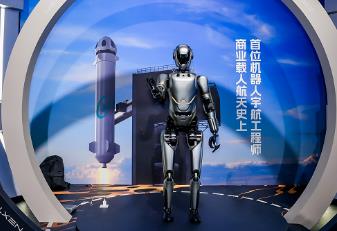
Recently, Galaxy General Robotics officially launched the embodied intelligent heavy-duty robot Galbot S1. As the first heavy-duty robot in the entire industry to achieve zero remote control, full autonomy, and sustainable operation, its two arms have a maximum load capacity of 50 kilograms, setting a new industry benchmark. What is worth noting is that the core embodied handling model of this product has been recognized as an important achievement in Beijing's artificial intelligence field. Dr. Wang He, an assistant professor at Peking University, the founder and chief technology officer of Galaxy General Robotics, officially presented and reported it at the Beijing Artificial Intelligence + Innovation Demonstration High Ground Conference to the city leaders and the leaders of the Development and Reform Commission, highlighting its dual value of technology and strategy.
Currently, the Galbot S1 has been applied on a large-scale production line by advanced manufacturing leaders such as Ningde Times. This marks that embodied intelligence has officially entered a new era of heavy-load industrial applications.
Responding to national strategies: Intelligent breakthroughs from the laboratory to the core of the industry
Currently, the manufacturing industry is undergoing a systematic transformation from scale expansion to quality improvement.
The development of new quality productive forces and the promotion of the deep integration of artificial intelligence and the real economy have become a clear direction. The launch of the Galaxy General Heavy-duty Robot is a concrete response to this strategy - it transforms cutting-edge AI technology into practical, replicable, and scalable industrial productivity.
At the promotion meeting for the construction of Beijing's artificial intelligence + innovation hub, Dr. Wang He reported to the attending leaders on the breakthroughs made by Galaxy General in the field of embodied intelligence. The self-developed heavy-duty robots and embodied handling models were released as representative achievements of artificial intelligence in Beijing. The release of this product and technology has filled the gap in heavy-load industrial applications in the humanoid robot industry and has opened a new chapter in embodied intelligent industrial productivity.
Re-defining standards: The true emergence of industrial-grade heavy-duty robots
The Galbot S1 was designed from the very beginning to simulate real industrial scenarios. It is meticulously forged to meet industrial-grade standards and features IP54 waterproof and dustproof capabilities as well as high-temperature resistance. It can reliably handle complex working conditions such as dust, vibration, and temperature variations. With an operating height of 2.3 meters, it covers an extremely large working area and truly adapts to various industrial environments ranging from warehousing to production lines.
It is designed for high-intensity, long-cycle, and continuous operation in industrial rhythms. It can also adapt to non-ideal working conditions such as dust, vibration, obstruction, and changes in lighting, and can operate stably in complex processes involving coexistence of humans and machines, cross-flow of logistics, and frequent adjustments of tasks.
More importantly, its load capacity is unprecedented in the industry: the maximum load capacity of both arms reaches 50kg. This indicator not only refreshes the industry's perception, but also means that the Galbot S1 can directly enter the key handling and transportation stages of the production process, becoming a core node that affects the rhythm, efficiency and safety, rather than an auxiliary peripheral device.
Evolution of Intelligent Systems: Industrial-grade Reliability from Perception to Decision Making
However, in real production environments, power is never the sole criterion. What truly determines whether a robot can "do the job" is its ability to continuously adapt to changes.
Manufacturing production lines often have more stringent requirements for embodied intelligence: Unlike highly automated production lines, robots need to adapt to handle materials, be able to move autonomously, and human-robot collaboration becomes the norm. This poses more challenges to robots, not only in the execution of actions, but also in the continuous perception, judgment, and response to environmental changes.
Based on the actual industrial demands, Galaxy General has built a embodied intelligent handling model for production scenarios using Galbot S1 as the foundation.
Based on the existing intelligent interaction and perception capabilities, this model places greater emphasis on certainty and reliability, ensuring that the robot can consistently and stably complete critical transportation tasks over the long term.
With the empowerment of the model, the Galbot S1 can achieve pure visual perception and no longer rely on QR codes or labels for positioning. It can still accurately locate and operate in complex factory environments.
It has strong anti-interference capabilities. Even in the case of changes in light, obstructions or dynamic interference, it can still complete the task stably.
With the aid of hard real-time response and 360° omnidirectional obstacle avoidance perception, the robot can flexibly adapt to dynamic environments and safely and efficiently carry out human-machine collaboration.
It is worth noting that based on the highly reliable electromechanical integration architecture and dual battery design, the Galbot S1 has the capability for long-range continuous operation - with an 8-hour ultra-long battery life and the ability to autonomously recharge, enabling 7×24-hour continuous operation, allowing the robot to truly meet the non-ideal and continuous operation requirements in real factories.
Based on actual needs, the Galbot S1 directly addresses the pain points in the industrial sector - not only is it more intelligent, but it can also operate autonomously and stably day after day on production lines with tight schedules.
Industrial Implementation Model: The Significance of the Paradigm Behind Nidec Corporation's Application
It is reported that the Galbot S1 has been successfully deployed on the production line of Ningde Times and is capable of autonomous operation without remote control. This marks that embodied intelligence has for the first time independently taken on the heavy tasks of key links in advanced manufacturing.
This marks that embodied intelligence has taken on the heavy responsibility of key links in advanced manufacturing, proving that its technical capabilities have matched the actual industrial demands; at the same time, this is not a single-point technology demonstration, but has formed a set of replicable and scalable productivity solutions. When leading manufacturing enterprises entrust their core production links to embodied intelligence systems, it reflects the recognition of the technical reliability and long-term value, and also means that "embodied intelligence productivity" has officially integrated into the main channel of industrial upgrading.
As the Galbot S1 enters the factory, a more universal question emerges: What role should embodied intelligence play?
The universal answer of the Galaxy is clear - the so-called "embodied intelligent productivity" is not about novel or more lightweight robots, but rather intelligent labor units that can be continuously deployed, operate stably, and achieve scale effects.
From an industrial perspective, this form of productivity is bringing about three major structural changes: bridging the gap between high-intensity labor and flexible demands, enhancing the stability and resilience of production systems, and promoting the transition of intelligence from local automation to bottom-level reconfiguration.
This is also the reason why the Galaxy universal product line maintains restraint - when the industry is constantly seeing the emergence of lightweight, portable and fun smart forms, they have chosen a more challenging path: to refine the "functionality" to the utmost.
Leading the creation of new quality productive forces with embodied intelligence
From a macro-industry perspective, the development path of embodied intelligence is diverging.
Most products emphasize lightweight design, portability and interactive experience, making them more suitable for display and dissemination; a few focus on high-strength, long-term tasks, continuously improving engineering reliability and system stability.
Galaxy General is the most representative enterprise of the latter.
This choice may not immediately draw much attention, but it is more in line with the long-term needs of industrial customers. On this path, embodied intelligence is no longer "novel technology", but gradually evolves into a production factor that can be evaluated, replicated, and scaled for deployment.
In this context, the value criteria of embodied intelligence have become increasingly clear: whether it can be applied in real scenarios, undertake real tasks, and consistently produce results over a long period of time.
The practical approach adopted by Galaxy is precisely based on this standard.
When the Galbot S1 successfully completed the heavy-load transportation task and was integrated into the factory's daily production system, embodied intelligence underwent a transformation from "observed technology" to "sustainable productivity". This not only marked the industry's advancement to the next stage, but also closely aligned with the country's manufacturing upgrade pace - starting from real needs and repeatedly refining in real scenarios, making the intelligent system truly become an integral part of the production system.
As Chinese manufacturing shifts from scale expansion to quality improvement, from single-point automation to system intelligence, and from factor-driven development to new quality productivity as the core, the truly crucial factor is whether technology can be integrated into the production system and generate long-term value output. Therefore, the choice of Galbot S1 is both pragmatic and strategic: it goes beyond concept verification, does not settle for display effects, but is determined to enter real scenarios and undergo long-term testing.
Its value lies not in the amount of weight lifted, but in marking the beginning of embodied intelligence truly entering the core of China's manufacturing: from heavy-load capacity to intelligent decision-making, from single-point products to productivity paradigms, from enterprise exploration to national strategies.
At this moment, embodied intelligence is no longer merely "seen", but is truly "used".