"This is not about moving robots into the factory; rather, it's about robots that have grown up within the factory itself."
While the manufacturing industry is still struggling to break through in the face of repetitive labor and hazardous environments, most of the cutting-edge humanoid robot technologies have remained at the stage of laboratory demonstrations - the wave of industrial intelligence calls for a truly scalable solution.
In the context of global industrial upgrading and technological competition, humanoid robots are regarded as the key carriers of the next generation of general artificial intelligence and the ultimate form for reshaping the manufacturing industry. International giants are continuously increasing their investment and layout, while domestic policy benefits are also being released simultaneously. "Embodied intelligence" has been included as a new growth point, and the "manufacturing power" and "robot+" initiatives are jointly promoted. The industry is entering a new stage centered on the implementation of scenarios and large-scale production.
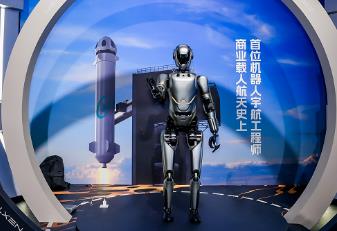
On December 29th, Xintida, with its status as an industry pioneer, officially launched the industry's first embodied intelligent robot, SYNDA R1, specifically designed for industrial use. This is not merely the debut of a product; it also marks a strategic leap for Xintida from the field of industrial robots and motion control to a key driver in the embodied intelligence industry. Starting from this point, Xintida has taken the lead in initiating the large-scale implementation and integration of embodied intelligence, establishing an industrial-grade embodied robot industrialization benchmark, and injecting a certain degree of future momentum into the deep evolution of the manufacturing industry.
During the strategic speech session, Liu Changwen, the CEO of Xinshida, stated that Xinshida will focus on high-value industrial scenarios, build an integrated ecosystem consisting of hardware, products, platforms and services, and promote embodied intelligent robots to move from "demonstration to large-scale application", truly creating perceivable productivity value for customers.
Hardcore strength breaks through boundaries: The industry-standard "exclusive genes" of SYNDA R1
Currently, the humanoid robot industry is confronted with a crucial paradox: there is a significant gap between the delicate demonstrations in laboratories and the demanding requirements in industrial settings. The industry generally faces three core pain points: most products lack specialized designs for industrial scenarios, and they have insufficient environmental tolerance and continuous operation capabilities; the system response is sluggish, and the precision fails to match the requirements of industrial production; there is a lack of unified "industrial adaptation" standards, which hinders the large-scale implementation.
In this context, Xintida was the first to propose and define "industrial-grade" as the core threshold for the industrialization of embodied intelligence. This is not only a product standard, but also represents a transformation in the industrial philosophy from "usable" to "reliable and durable". SYNDA R1 is the concrete implementation of this standard.
SYNDA R1 is developed based on the core principle of "industrial-grade", and it has built comprehensive industrial adaptability capabilities:
Self-developed integrated multi-layer heterogeneous intelligent control system: Equipped with an integrated multi-layer heterogeneous controller for perception, planning and operation control. Compared to the traditional loosely coupled solution, it offers faster response speed and better system stability, providing core technical support for industrial-level operations.
Industrial-grade operation capability: Optional flexible hands or grippers can be equipped, supporting typical industrial tasks such as assembly, grasping, and transportation, enabling precise operations at the millimeter level, and accurately meeting the high precision requirements of industrial production.
Self-charging, 24/7 continuous operation: With the dual battery hot-swappable self-charging and automatic recharging technology, it breaks the range limitation and enables uninterrupted operation around the clock, perfectly adapting to the continuous rhythm of industrial production.
Adaptive to complex industrial environments, human-machine collaboration safety: Four-chamber wheeled chassis, 3D laser radar, omnidirectional flexible obstacle avoidance, achieving stable and safe movement and all-round protection in complex industrial scenarios, ensuring human-machine collaboration safety.
Wide-range flexible operation coverage: The dual arms can be equipped with loads of 3/5/12KG. The upper limb rotation angle can reach -180° to 180°. The waist lifting range is 0 to 61cm. The operation height range is 0 to 210cm. The operation diameter is 195cm. It can flexibly adapt to multi-dimensional industrial operation requirements.
All-stack self-developed high-performance, high-torque, lightweight joint module: Bus nanosecond-level synchronization, one-click self-tuning, full-band vibration suppression, helping robots be more stable. High-integration single-board drive and partial high-integration harmonic reducer, combined with ultra-thin component design, achieve a total weight reduction of 5kg; Multi-pole multi-slot frameless motor increases torque density by 20%, ensuring durability for long-term continuous operation in industrial scenarios.
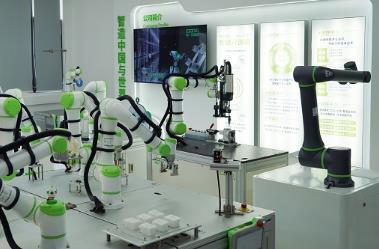
At present, Xinshida has established a four-product line of physical entities based on industrial-grade standards, namely collaborative robots, mobile composite robots, wheeled humanoid robots, and bipedal humanoid robots. This indicates that its industrialization path is not based on a single product breakthrough, but rather through a platformized and modularized product family, it provides customers with a gradient solution covering different scenarios and different complexity requirements, laying a systematic foundation for large-scale expansion.
From Laboratory to Factory: The "Practical Implementation" Journey of SYNDA R1
The ultimate test for industrial robots lies in their large-scale application in real scenarios. Currently, the industry is generally confronted with two major challenges: the "data desert" and the "scenario gap". The sterile environment of the laboratory is vastly different from the complex working conditions of the factory. The lack of large-scale and high-quality real-world interaction data leads to insufficient generalization ability of the algorithm models in practical applications.
At the event site, Gao Xuan, the secretary-general of the Shanghai Intelligent Manufacturing Association, stated that the journey from laboratory demonstrations to stable production in factories is still a long one. The birth of this humanoid robot, which combines innovation and pragmatism, in this hotbed of intelligent manufacturing in Shanghai is no coincidence. It is not only a milestone in enterprise innovation but also vividly demonstrates Shanghai's determination and strength in building a world-class intelligent manufacturing cluster.
The unique advantage of Xinshida lies in the fact that its industrialization path began in the real industrial environment. Leveraging the deep ecological synergy advantages gained after strategic investment by Haier, Xinshida uses 163 factories under Haier that cover the entire industrial chain as a "natural testing ground". SYNDA R1, from the very beginning of its development, directly faced real industrial challenges such as noise, vibration, and multi-task interference. This "born in the factory and used in the factory" model ensures that its data accumulation, algorithm iteration, and engineering optimization always resonate in sync with industrial demands, effectively ensuring that the product performance is highly compatible with industrial requirements.
Apart from the challenge of implementing the concept, the industry also faces a test of its delivery capabilities: Currently, the delivery level in the humanoid robot sector generally lags behind the growth of orders. Most enterprises are still in the early stage of gradually increasing their shipments from the hundreds of units to the thousands of units. In 2024, Yushu Technology ranked first in global humanoid robot shipments with 1,400 units, but the "thousand-unit" achievement is still rare within the industry. It is evident that delivery capabilities will be the core for enterprises to break through in the next stage.
On a deeper level, large-scale delivery tests the comprehensive manufacturing and supply chain capabilities of an enterprise. Shengxin Da has a national Ministry of Industry and Information Technology-certified intelligent manufacturing demonstration factory, and was rated as one of the first batch of benchmark intelligent factories in Shanghai. With an annual production capacity of up to 10,000 industrial robots, it provides a solid "mass production foundation". This is not just about the production capacity figures; it also represents mature supply chain management, digital production processes, and strict quality consistency control systems. In the middle stage of industrialization, delivery capability is itself one of the core technical barriers.
Currently, the industrialization exploration of SYNDA R1 has made significant progress: In real scenarios such as the Chongqing factory, it has initially achieved the implementation of typical tasks such as adaptive grasping, warehouse logistics handling, flexible PCB board card quality inspection, and dual-arm collaborative assembly. This verifies that it is not only a technical platform but also a productive tool that can generate value immediately.
Ecological Momentum: Accelerating the Industrialization of Embodied Intelligent Robots
The intelligent upgrading of the manufacturing industry is not a solo show by a single enterprise. It is a systematic project that requires the collaboration of software, hardware, platforms, as well as the coordination of the upstream and downstream links of the industrial chain. The industrialization exploration of Xinshida is precisely aimed at breaking industry barriers through ecological synergy and promoting the widespread application of embodied intelligent robots.
The intelligent upgrading of the manufacturing industry is a systemic revolution that cannot be driven by a single piece of hardware. It requires the integration of a "perception-decision-execution" hardware loop, a software layer that seamlessly connects with the production system (MES/ERP), and platform capabilities for data circulation and resource scheduling. In terms of policies, the country encourages the establishment of an innovation ecosystem that integrates large, medium, and small enterprises, and supports the development of industrial internet platforms. Newtime's industrialization path is precisely to address this systemic challenge by leveraging the power of the ecosystem.
The core competitive edge of Xinshida originates from its dual driving forces of the "30-year industrial DNA" and "strategic ecological synergy". From the perspective of industrial foundation, Xinshida adheres to the deep-seated concept of "rooted in industry and understanding industry better", and has consolidated its development foundation by leveraging the 30-year accumulation in the field of industrial automation. As one of the few manufacturers in the industry that started from motion control technology and extended from controllers to robot body manufacturing, Xinshida has established a full industrial chain layout of core components - robot bodies - system integration, and has constructed a differentiated competitive barrier with core technologies such as drive and control integration and multi-core heterogeneous architecture. Its SCARA robots have firmly occupied the first echelon of domestic brands.
From the perspective of strategic synergy, after Haier's strategic investment in 2025, Shenti Da officially became a new member of Haier's ecosystem. The two parties, leveraging their respective advantages, achieved in-depth synergy. Shenti Da's advanced hardware R&D and manufacturing capabilities in the field of industrial automation were deeply integrated with Kaos's industrial internet platform foundation capabilities, IT layer software capabilities, and solution capabilities, forming a complete closed loop of "software - hardware - platform", providing strong support for the scene implementation and ecosystem expansion of embodied robots.
Based on this, Shengshida has established an open cooperative ecosystem, collaborating with Alibaba Cloud, NVIDIA, ByteDance, and others in areas such as cloud computing, AI computing power, and development frameworks. This open strategy enables it to integrate the world's top resources, build an industry ecosystem with complementary advantages and collaborative innovation, accelerate the iteration and expansion of embodied intelligent technologies, and promote the industrialization process of humanoid industrial robots to "run faster".
Conclusion: The Unlimited Potential of Reconstructing Productivity
When SYNDA R1 completed its first task on the production line, it signified not only the success of a product, but also the beginning of a new era - that embodied intelligence has truly entered the core of industrial production.
Based on this milestone, the future path of Xinshida is already clear: to lay a reliable foundation with industrial-grade standards, to continuously evolve driven by real-scene data, and to gather leapfrog power through an open industrial ecosystem. Its goal is not only to deliver robots, but also to work with industry partners to jointly promote the profound transformation of China's manufacturing industry, and to mark a distinct Chinese innovation coordinate in the new map of global intelligent manufacturing.